Digital Periegesis
About
The Project: The Project
2025-12-01
Context & Aim
The second-century CE narrative, the Periegesis Hellados by Pausanias, represents a unique first-hand account from antiquity of the built environment of the ancient Greek mainland. Structuring his narrative in the form of a journey from Athens to Delphi via the Peloponnese, Pausanias takes his reader on a deep dive into some of Greece’s primary cultural sites (Athens, Corinth, Argos, Olympia, Thebes, Delphi, etc.), describing the sights worth seeing and relating accounts about them (e.g., 1.39.3). In this way, Pausanias challenges modern ways of viewing by relating places and objects as much through the stories that bind them as by their topographical proximity.
The Digital Periegesis represents the first concerted effort to capture this information in a systematic and consistent manner, and publish the results for general use according to Linked Open Data FAIR principles. As both a source of data and a set of tools for exploring it, the Digital Periegesis enables exploration of the role of place and the interplay of people, objects, events and stories in Pausanias’s narrative through maps, visualizations and links to other related resources.
Data Enriching
The project began by uploading the Greek TEI text available from the Perseus Classical Library into the free open-source annotation platform Recogito, developed by Pelagios. Recogito enabled us to semantically annotate place, person, and event information.
Place references to settlements and physical features were disambiguated by aligning as many of them as possible to Pleiades, a well-established digital gazetteer of the ancient world, while more granular aspects of the built environment — sanctuaries, temples, theatres, other public buildings — were matched with ToposText records and/or to Arachne, the German Archaeological Institute’s huge database of ancient monuments. References to People, Events and other key concepts were tagged using Wikidata, the machine-readable open knowledge base behind Wikipedia, in the process creating hundreds of new Wikidata items for general use. Annotating the text of Pausanias with the Uniform Resource Identifiers (URIs) of these resources provides the basis for making our data public as Linked Open Data (LOD).
Other key resources we link to include Manto (for Greek mythological themes), Itiner-e (for ancient road segments), and Mapping Ancient Polytheisms (for divine epithets). In raw data terms, the Digital Periegesis has annotated: 4225 places, 1762 objects/artworks, 3882 people/groups, 161 cited ancient texts, and (still in progress) over 1000 events and some 1500 logoi recorded by Pausanias.
Data Processing and Publication
To consolidate our data for publication and to enable the exploration of the relations between places, objects and people, we imported our Recogito annotations into Nodegoat, a powerful relational database and visualization platform for humanities research. In Nodegoat, each paragraph of Pausanias is its own entity, mapped to a location (where the reader is positioned), which serves as a surrogate chronology (one day per paragraph) for time-series visualizations. In addition to having the entities of Place, Object, Persons and Events, and their relations, searchable, all internal references to other passages in the narrative and external reference to passages from other authors have been marked. All these data are made available via a dedicated Nodegoat instance of the Digital Periegesis, in the form of either public visualizations or raw data downloads. For access to a zipped file of the full Nodegoat dataset, or for view/filter/download access to our main research instance, send us an email at pausanias@periegesis.org.
The current Digital Perigesis website offers these data in different views: (i) side-by-side English and Greek text of Pausanias with an underlying map linked to the named places in the Greek text, and Wikipedia or Wikidata links in the English text; (ii) a Search in Maps library of downloadable maps in various formats, giving searchable, filterable access not only the places and artworks Pausanias mentions but also a Wikidata-based dataset of modern Greek locations with population information; (iii) tables of csv data from Recogito, Nodegoat, and Wikidata for filtering and download; and (iv) a Peripleo instance that enables another mode of dynamic browsing of the Greek text and the places and objects mentioned in it.
In this way, as much as it being a project with specific research questions and aims, the Digital Periegesis is contributing to the Public Humanities, by publishing data that can be openly accessed and reused, developing methods that can be reproducible, and helping to build tools that are open source and interoperable within the broader LOD ecosystem.
The Team
The Digital Periegesis team are: Anna Foka (Uppsala University), Elton Barker (The Open University), Kyriaki Konstantinidou (Institute for Mediterranean Studies, Swedish Institute at Athens), Linda Talatas (Swedish Institute at Athens), and Brady Kiesling (ToposText, Swedish Institute at Athens). For the Digital Periegesis website wizardry: Fotis Theodoridis (Södertörn). For Nodegoat: Pim van Bree and Geert Kessels. Other colleagues who have joined us along the way include: Cenk Demiroglou and Kajsa Palm (Umeå University); and Nasrin Mostofian, Vasiliki Tsoumari and Alexandros Kokkinides (Uppsala University).
The Digital Periegesis was made possible by funding from the Marcus and Amalia Wallenberg Foundation and the Swedish Research Council.
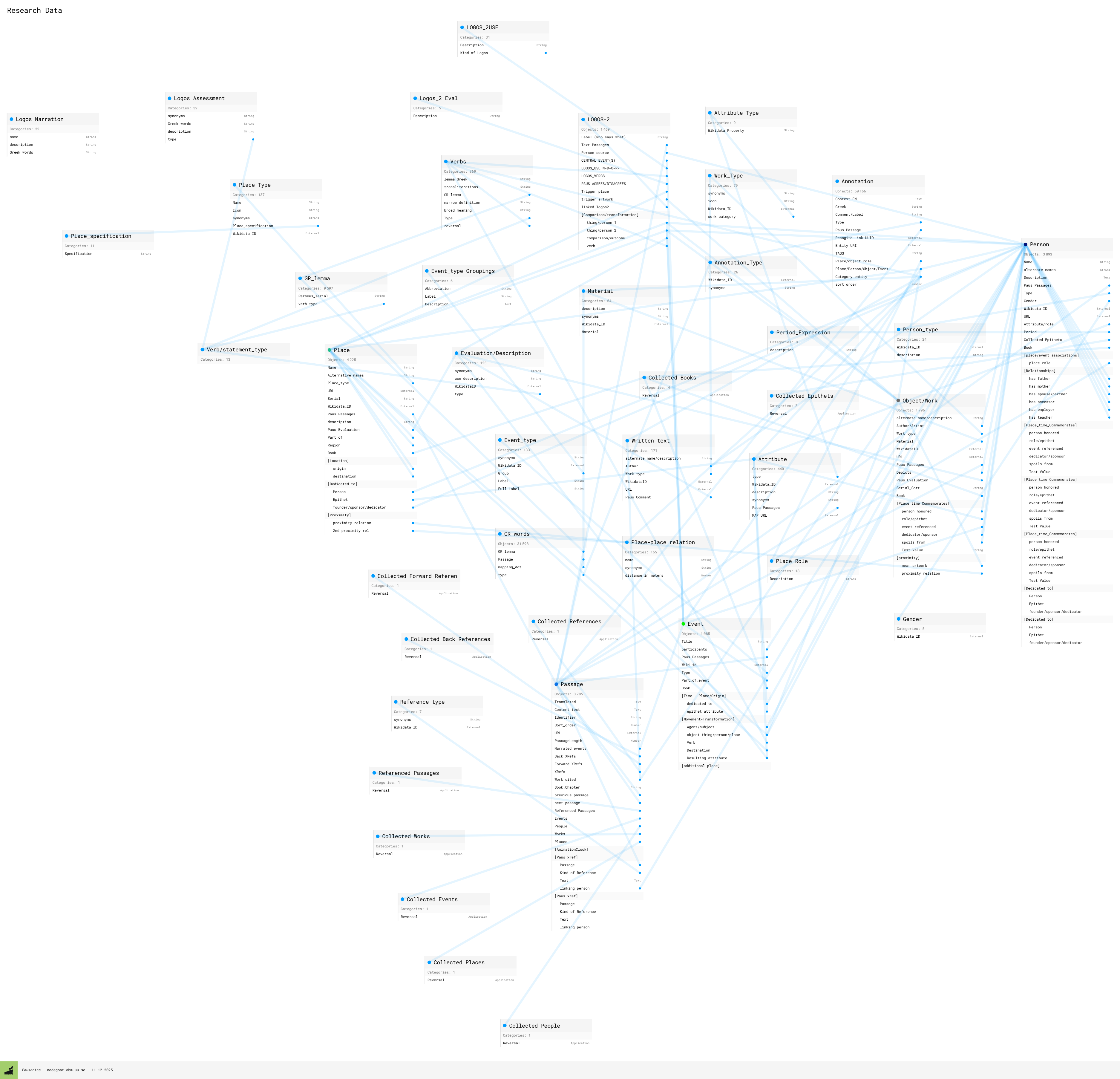
Pausanias data model in Nodegoat, 2025-12-11
Printed 2026-01-21
From the web page Digital Periegesis
www.periegesis.org/en/sx_PrintPage.php?aboutid=11